
Calculate the following time estimates for each activity. Earliest Start Time(EST) Earliest Finish Time(EFT) Latest Start Time(LST) Latest Finish Time(LFT)

Calculate EST, EFT, LST and LFT in a Network Diagram
In project management, network diagrams are used to plan, schedule, and control project activities. Using the Critical Path Method (CPM), we calculate time parameters such as Earliest Start Time (EST), Earliest Finish Time (EFT), Latest Start Time (LST), and Latest Finish Time (LFT).
Given Network Diagram
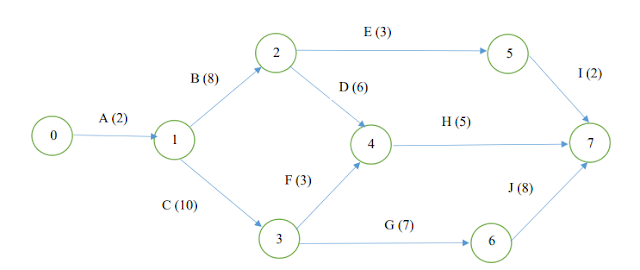
Required
Calculate the following time estimates for each activity:
- Earliest Start Time (EST)
- Earliest Finish Time (EFT)
- Latest Start Time (LST)
- Latest Finish Time (LFT)
Formulas Used
- EFT = EST + Duration
- LST = LFT − Duration
Solution Table
| Activity | Duration | EST | EFT | LST | LFT |
|---|---|---|---|---|---|
| 0–1 | 2 | 0 | 2 | 0 | 2 |
| 1–2 | 8 | 2 | 10 | 8 | 16 |
| 1–3 | 10 | 2 | 12 | 2 | 12 |
| 2–4 | 6 | 10 | 16 | 16 | 22 |
| 2–5 | 3 | 10 | 13 | 22 | 25 |
| 3–4 | 3 | 12 | 15 | 19 | 22 |
| 3–6 | 7 | 12 | 19 | 12 | 19 |
| 4–7 | 5 | 16 | 21 | 22 | 27 |
| 5–7 | 2 | 13 | 15 | 25 | 27 |
| 6–7 | 8 | 19 | 27 | 19 | 27 |
Explanation
The forward pass is used to calculate EST and EFT, starting from the initial node. The backward pass is applied to compute LST and LFT, beginning from the final node. Activities with zero slack lie on the critical path and directly affect the project duration.
Internal Links (QueryPoint Official)
- PERT Time Estimates – Expected Time & Variance
- Time Estimates for PERT Activities
- What is Research Methodology?
Frequently Asked Questions (FAQs)
What is EST in CPM?
EST is the earliest possible time an activity can start without delaying previous activities.
What is LFT?
LFT is the latest time an activity can finish without delaying the project.
Why are EST and LST important?
They help identify critical activities and manage project scheduling efficiently.
Explore more about OPERATIONS RESEARCH in Mathematics Notes & MCQs.
Query Point Official – Smart Notes for Exams & Conceptual Learning
No comments